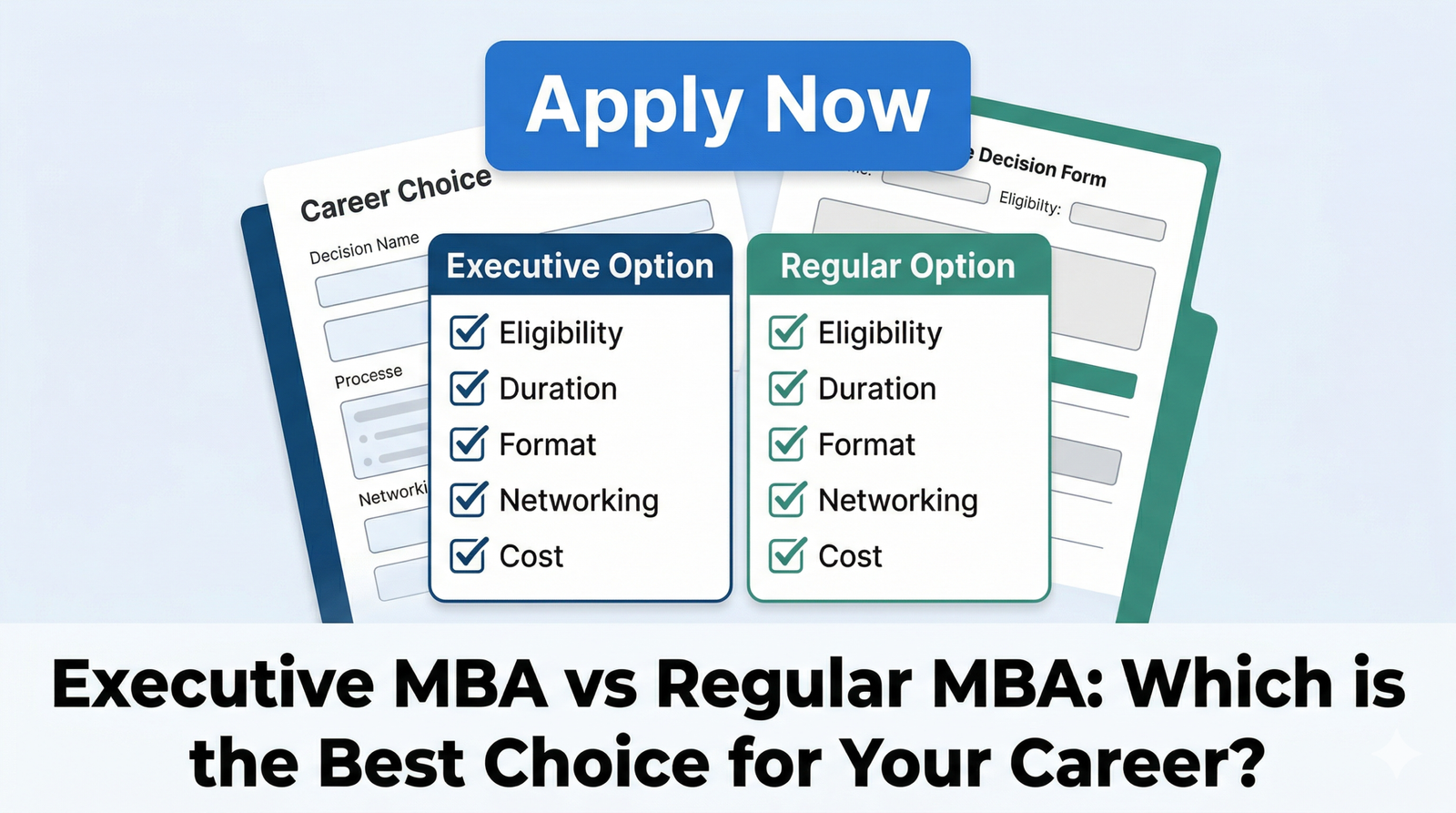
In the fast-paced, highly competitive corporate ecosystem of 2026, pursuing a Master of Business Administration (MBA) is one of the most effective ways to accelerate your career, increase your earning potential, and develop robust leadership skills. However, as professionals look to upgrade their educational qualifications, they are often faced with a critical crossroad: should they choose an Executive MBA (EMBA) or a Regular (Traditional) MBA?
Making the right choice between these two prestigious academic paths can significantly alter your professional trajectory. A Regular MBA is designed as an immersive, transformative experience primarily aimed at early-career professionals who wish to build a strong foundation in business principles or pivot to an entirely new industry.
Related Posts:



On the other hand, an Executive MBA is tailored for seasoned professionals and mid-to-senior level managers who want to refine their strategic leadership skills without putting their current careers on hold.
Both programs offer incredible networking opportunities, top-tier academic rigor, and significant salary bumps upon graduation. Yet, they cater to very different demographics, feature distinct classroom dynamics, and demand different levels of time commitment. This comprehensive guide will dissect every aspect of the “Executive MBA vs Regular MBA” debate—covering benefits, eligibility, application processes, and more—to help you make the most informed decision for your future.
Detailed Benefits: EMBA vs Regular MBA
Understanding the unique advantages of each program is the first step in determining which path aligns best with your personal and professional aspirations.
Benefits of an Executive MBA (EMBA)
- Earning While Learning: The most immediate benefit of an EMBA is that it allows you to maintain your full-time job. Classes are typically held on weekends, evenings, or in modular formats. This means you do not lose your income for two years, making the financial burden much easier to manage.
- Immediate Application of Skills: Because EMBA students are working simultaneously, they can take the frameworks, leadership strategies, and problem-solving techniques learned in class on a Saturday and apply them in their corporate boardroom on Monday.
- High-Level Peer Networking: The EMBA classroom is filled with experienced directors, VPs, and seasoned entrepreneurs. The quality of discussions is deeply practical, and the networking opportunities often lead to high-level B2B partnerships, board placements, or co-founding opportunities.
- Employer Sponsorship: Many corporations are willing to sponsor part or all of their employees’ EMBA tuition, viewing it as a direct investment in the company’s future leadership pipeline.
Benefits of a Regular MBA
- Immersive Campus Experience: A full-time Regular MBA offers an unparalleled immersive environment. You have the time to join student clubs, participate in global case competitions, and engage deeply in academic research without the distraction of a demanding full-time job.
- Facilitates Major Career Pivots: If you want to completely change your industry (e.g., moving from IT to Investment Banking) or job function, a Regular MBA is the superior choice. The inclusion of summer internships provides the crucial stepping stone needed to transition into a new field.
- Comprehensive Foundational Learning: Regular MBA programs dive deep into the absolute basics of finance, marketing, operations, and human resources, making it ideal for those who might not have extensive hands-on experience in these areas.
- Dedicated Campus Placements: Traditional MBA programs boast highly structured campus recruitment drives. Top global firms visit campuses specifically to hire full-time MBA graduates for high-paying associate and managerial roles.
Comparative Overview: Breaking Down the Differences
To give you a clearer perspective, here are two tables detailing the fundamental differences between an Executive MBA and a Regular MBA in 2026.
Table 1: Core Structural Differences
| Feature | Regular (Full-Time) MBA | Executive MBA (EMBA) |
| Target Audience | Early-career professionals (0-4 years exp.) | Mid-to-senior managers (5-15+ years exp.) |
| Program Duration | Typically 24 months (Full-time) | 12 to 24 months (Part-time/Modular) |
| Class Schedule | Monday to Friday (Daytime classes) | Weekends, Evenings, or Bi-monthly modules |
| Curriculum Focus | Foundational and tactical business skills | Strategic leadership and advanced management |
| Internship Requirement | Mandatory 2-to-3-month summer internship | No internship required (students are working) |
Table 2: Financial and Career Impact
| Feature | Regular (Full-Time) MBA | Executive MBA (EMBA) |
| Opportunity Cost | High (Loss of salary for 2 years) | Low (Continuous salary progression) |
| Corporate Sponsorship | Very Rare | Highly Common |
| Primary Career Goal | Career pivot, entering management | Climbing the current corporate ladder faster |
| Networking Quality | Broad peer network, high alumni engagement | Highly targeted, senior executive connections |
Eligibility Criteria
Because these programs target different phases of a professional’s career, their eligibility requirements are distinctly unique.
Eligibility for an Executive MBA
- Work Experience: The defining criterion. Top-tier EMBA programs require a minimum of 5 to 7 years of full-time work experience, with a significant portion of that time spent in a managerial or leadership capacity.
- Academic Qualifications: A Bachelor’s degree from a recognized university with an acceptable GPA.
- Standardized Tests: While some universities accept GMAT or GRE scores, many prefer the Executive Assessment (EA), which is specifically designed for busy professionals. Additionally, a large number of business schools offer test waivers based on extensive work experience.
- Employer Approval: Some programs require a “Time Sponsorship” letter from your current employer, acknowledging that you will need specific days off to attend modular residencies.
Eligibility for a Regular MBA
- Work Experience: Most top programs prefer candidates with 2 to 4 years of work experience, though some elite institutions accept exceptional fresh graduates right out of college.
- Academic Qualifications: A robust undergraduate degree in any discipline with a competitive academic record (high GPA/percentages).
- Standardized Tests: A strong GMAT or GRE score is almost universally required for top-ranked global programs.
- Language Proficiency: For international candidates, TOEFL, IELTS, or PTE scores are mandatory to prove English language proficiency.
Required Documents for Admission
Whether you choose an EMBA or a Regular MBA, assembling a strong portfolio of documents is crucial. Ensure you have the following ready:
- Detailed Resume/CV: For an EMBA, focus heavily on leadership achievements, team sizes managed, and revenue impact. For a Regular MBA, highlight growth, adaptability, and extracurricular involvement.
- Academic Transcripts: Official mark sheets and degree certificates from your undergraduate and any postgraduate institutions.
- Letters of Recommendation (LORs): Typically two are required. EMBA applicants should get these from current managers or CEOs. Regular MBA applicants can use direct supervisors or academic professors.
- Statement of Purpose (SOP) / Admission Essays: Comprehensive essays explaining why you are choosing this specific program, your short-term and long-term career goals, and what unique value you bring to the cohort.
- Standardized Test Scorecards: Official GMAT, GRE, EA, or language proficiency test scores.
- Corporate Sponsorship Letter (If applicable): Essential for EMBA candidates who are receiving financial or time-off support from their companies.
- Identity and Travel Documents: A valid passport and government ID proofs.
Online and Offline Application Process
The application process for business schools in 2026 is highly streamlined, offering both digital and traditional avenues.
The Online Application Process
- Portal Registration: Visit the official website of the target business school and create an applicant profile.
- Select the Program: Carefully select either “Full-Time MBA” or “Executive MBA” from the drop-down menus.
- Complete the Digital Form: Fill out all personal, academic, and professional details. Be meticulous about employment dates and job titles.
- Upload Documents: Attach your essays, resume, LORs, and scanned transcripts in the requested formats (usually PDF).
- Pay the Fee: Submit the non-refundable application fee using a credit card or international payment gateway.
- Video Assessment: Many top schools now require a live or pre-recorded video essay submission immediately after paying the fee.
The Offline Application Process
Though rare in 2026, some regional or specialized institutions still permit offline submissions:
- Obtain the Brochure and Form: Purchase the physical admission packet from the university campus or authorized regional centers.
- Manual Entry: Fill out the paper application using a black or blue pen, ensuring no overwriting.
- Attach Physical Copies: Enclose self-attested photocopies of all your academic and professional documents.
- Demand Draft (DD): Generate a DD from your bank for the application fee, payable to the university.
- Mailing: Send the complete application dossier via registered courier to the university’s admission board before the final deadline.
How to Check Admission List and Application Status
Waiting for the admission results can be nerve-wracking. Here is how you can systematically track your application:
- University Admission Portal: The quickest way to check your status is by logging into the same portal where you submitted your application. Universities update statuses like “Under Review,” “Interview Shortlisted,” or “Final Decision Rendered” in real-time.
- Email Communication: Admission committees communicate exclusively via the email address you provided. Keep a close eye on your inbox for interview invitations or requests for additional documentation.
- Official Merit Lists: For public universities or region-specific institutions, final merit lists are often uploaded as downloadable PDFs on the website’s homepage or notice board.
- Contacting the Admissions Office: If a deadline has passed and you have not received an update, you can call or email the admissions office. EMBA applicants are often assigned a dedicated relationship manager who can provide direct updates.
Frequently Asked Questions (FAQs)
1. Which program offers better salary hikes, an EMBA or a Regular MBA?
In terms of pure percentages, a Regular MBA often shows a higher jump (sometimes 50-100%) because the candidate is starting from a lower base salary. EMBA graduates usually experience a 15-30% bump; however, their base salaries are already significantly higher, meaning the absolute monetary gain is often massive.
2. Is an EMBA considered a “real” MBA degree?
Yes, absolutely. Upon graduation, your degree will hold the exact same academic weight as a Regular MBA. Most university transcripts simply read “Master of Business Administration,” without distinguishing the executive format.
3. I am 35 years old. Should I apply for a Regular MBA?
While you can technically apply for a Regular MBA, an EMBA or a 1-year mid-career MBA might be a better fit. In a Regular MBA, your peers will likely be in their mid-20s, and the campus recruitment process targets junior-to-mid level roles, which might be a step backward for your career.
4. Which program is more academically rigorous?
Both are equally rigorous, but the focus differs. A Regular MBA is heavy on textbooks, exams, and foundational theories. An EMBA is rigorous in its demand for practical application, case study analysis, and managing the intense pressure of balancing a full-time job with top-tier academics.
5. Do I need an internship if I do an EMBA?
No. Because EMBA students are fully employed, the program relies on the student’s current job to serve as the “living laboratory” where they apply the concepts learned in class.
6. Can I switch industries with an Executive MBA?
It is possible, but much harder compared to a Regular MBA. An EMBA is designed to accelerate growth within your current industry or function. If a total career pivot is your goal, the internships provided by a Regular MBA are crucial.
Conclusion
Deciding between an Executive MBA and a Regular MBA boils down to where you currently stand in your professional journey and where you intend to go. If you are in the early stages of your career, looking to aggressively climb the ladder, switch industries, and immerse yourself entirely in the academic and networking experience, the Regular MBA is your definitive choice.
Conversely, if you are an established leader, a seasoned manager, or an executive who cannot afford to step away from the corporate world but needs advanced strategic insights to reach the C-suite, the Executive MBA is tailor-made for you. Evaluate your years of experience, your financial capacity to absorb an opportunity cost, and your long-term career trajectory. Whichever path you choose, an MBA from a reputable institution remains one of the most powerful catalysts for professional success in 2026.