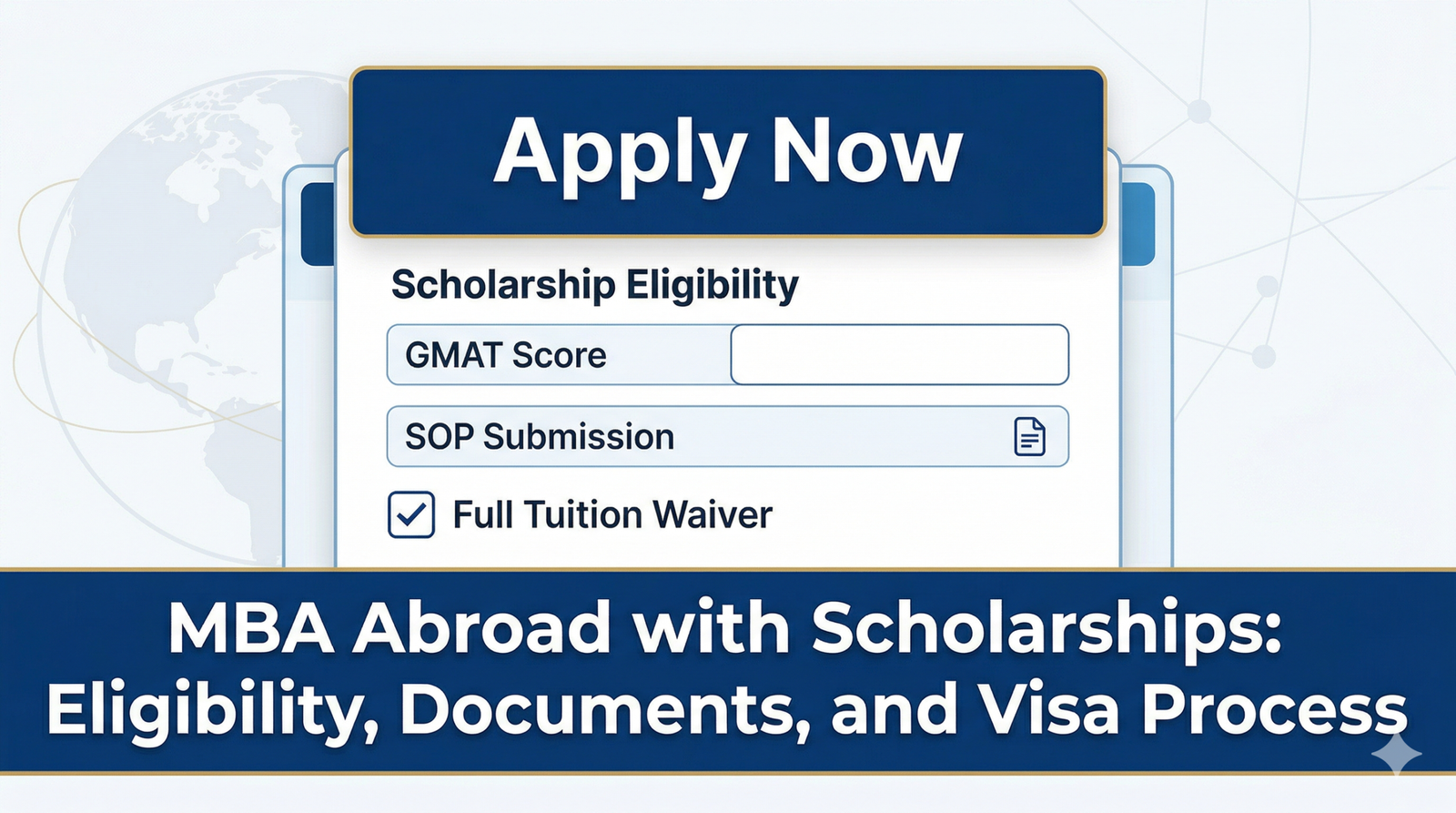
Studying for a Master of Business Administration (MBA) abroad is a dream for countless professionals and students in 2026. It is a transformational journey that offers far more than just a postgraduate degree.
An international MBA provides unparalleled global exposure, immersing you in diverse cultures and international business practices. It transforms the way you approach corporate problem-solving and leadership on a global scale.
Related Posts:

However, the primary hurdle that stops most brilliant minds from taking this leap is the exorbitant cost of international tuition and living expenses. Premier business schools in the US, UK, Canada, and Australia can be financially draining without proper planning.
This is exactly why securing a scholarship is the most critical step in your study-abroad journey. Scholarships not only reduce your financial burden but also add massive prestige to your professional resume.
A fully-funded or partially-funded scholarship proves to future employers that you are a highly meritorious and globally competitive candidate. It sets you apart from the crowd before you even attend your first class.
In this comprehensive guide, we will break down everything you need to know about pursuing an MBA abroad with scholarships. We will cover the profound benefits, strict eligibility criteria, essential documents, the application process, and the all-important visa procedures.
Detailed Benefits of Studying an MBA Abroad
Choosing to pack your bags and study business in a foreign country comes with a multitude of career-defining advantages. Let us explore these benefits in detail.
1. Global Networking and Alumni Connections
When you study abroad, your classroom is filled with peers from over fifty different countries. You build a deeply diverse and powerful global network.
These connections often turn into lifelong friendships, international business partnerships, and high-level corporate referrals. Access to a global alumni network is arguably the highest ROI of an international MBA.
2. Significantly Higher Earning Potential
Graduating from a top-tier international business school drastically increases your market value. Multinational corporations are always hunting for leaders with global perspectives.
You will often command starting salaries paid in strong currencies like Dollars, Pounds, or Euros. This allows you to pay off any remaining educational loans incredibly fast and build wealth early.
3. Post-Study Work Visas and Immigration Options
Countries like the USA, UK, Canada, and Australia offer highly attractive post-study work (PSW) visas to international graduates. For example, STEM-designated MBAs in the US allow up to 3 years of work authorization.
This gives you the chance to gain international work experience right after graduation. For many, it also serves as the first major step toward permanent residency or long-term immigration.
4. Personal Growth and Independence
Moving to a new country forces you out of your comfort zone. You have to manage your finances, navigate a new culture, and build a life from scratch.
This builds immense resilience, adaptability, and cross-cultural communication skills. These soft skills are exactly what top global recruiters look for in their executive leadership teams.
Eligibility Criteria for MBA Abroad and Scholarships
Securing an admission and a scholarship requires you to meet strict, globally competitive benchmarks. Here is what top international admission committees expect from you:
- Strong Academic Record: You need a recognized Bachelor’s degree (usually 3 or 4 years) from an accredited university. A high Grade Point Average (GPA) or a First-Class distinction is highly preferred for scholarship consideration.
- Standardized Entrance Exams: A top-tier GMAT or GRE score is the biggest factor in winning merit-based scholarships. Scores above 700 on the GMAT significantly boost your chances of getting financial aid.
- Language Proficiency: You must prove your ability to communicate in English. Valid, high scores in standardized tests like IELTS, TOEFL, or PTE Academic are completely mandatory.
- Relevant Work Experience: Most reputed international MBA programs require a minimum of 2 to 5 years of full-time work experience. Demonstrating leadership and career progression during this time is crucial for scholarships.
- Extracurricular and Social Impact: Scholarship committees look for well-rounded individuals. Volunteering experience, NGO work, or leadership in community initiatives makes your profile highly attractive.
Required Documents for Admission and Scholarships
Your application dossier is your only chance to impress the international admission board. You must meticulously prepare the following documents well in advance:
- Academic Transcripts and Degree Certificates: You need official, translated, and stamped transcripts from your high school and all years of your undergraduate degree.
- Statement of Purpose (SOP): A brilliantly crafted 1-2 page essay. It must outline your career goals, why you chose that specific country/university, and how the scholarship will impact your journey.
- Letters of Recommendation (LORs): Usually two to three professional LORs are required. These should be from direct managers or supervisors who can explicitly vouch for your leadership potential and work ethic.
- Scholarship Essays: Many universities require a separate essay specifically for scholarship evaluation. This essay usually asks you to demonstrate your leadership experiences or commitment to diversity.
- Updated Global Resume/CV: A one-page, impact-driven resume. Use the XYZ formula (Accomplished X as measured by Y, by doing Z) to highlight your professional achievements clearly.
- Valid Passport: A passport valid for at least six months beyond your intended period of study is mandatory for both the application and the visa process.
Top Destinations, Scholarships, and Career Scope
To give you a clear strategic overview, here are detailed tables breaking down top study destinations, famous scholarships, and expected returns on investment.
Table 1: Top Countries and Post-Study Work Visa (PSW) Rules
| Study Destination | Average Annual Tuition Fee | Post-Study Work Visa Duration | Top Industries for Hiring |
| United States | $50,000 – $80,000 | 1 Year (Up to 3 Years for STEM MBA) | Tech, Consulting, Finance |
| United Kingdom | £30,000 – £60,000 | 2 Years (Graduate Route Visa) | Banking, Healthcare, FMCG |
| Canada | CAD 40,000 – CAD 80,000 | Up to 3 Years (PGWP) | Supply Chain, IT, Finance |
| Australia | AUD 45,000 – AUD 70,000 | 2 to 3 Years (Temporary Graduate) | Mining, Consulting, Retail |
| Germany | Free to €15,000 | 18 Months | Automotive, Tech, Manufacturing |
Table 2: Top Global Scholarships for International MBA Students
| Scholarship Name | Provider | Coverage / Reward Amount | Target Audience |
| Chevening Scholarship | UK Government | Fully Funded (Tuition + Living + Flights) | Global leaders with 2+ years exp. |
| Fulbright Scholarship | US Government | Fully Funded (Tuition + Living) | High-achieving international students |
| INSEAD Diversity Scholarships | INSEAD Business School | €10,000 to €25,000 | Candidates bringing diversity |
| Felix Scholarships | Select UK Universities | Fully Funded | Underprivileged students from India/Africa |
Table 3: Average Starting Salaries Post-MBA
| Country of Graduation | Average Starting Salary | Estimated Payback Period (With Loan) |
| USA | $120,000 – $160,000 | 3 to 4 Years |
| UK | £60,000 – £90,000 | 3 to 4 Years |
| Canada | CAD 85,000 – CAD 110,000 | 2.5 to 3.5 Years |
Online and Offline Application Process
Applying to universities abroad is almost entirely a digital process in 2026. However, meticulous attention to detail is required at every single step.
The Online Application Process
- Shortlist and Register: Create a free account on the official admissions portal of your target business school. Note down the specific deadlines for “Round 1” and “Round 2” applications.
- Fill the Application: Carefully enter your demographic details, academic history, and chronological work experience. Ensure there are absolutely no spelling errors.
- Upload Documents: Upload your SOP, Resume, LORs, and scanned Transcripts in high-resolution PDF formats. Most portals have strict file size limits, so compress them if necessary.
- Submit Test Scores: Request the official testing bodies (GMAC, ETS, British Council) to send your standardized test scores (GMAT/TOEFL/IELTS) directly to the university code.
- Apply for Scholarships: Check the box that says “Consider me for merit-based scholarships.” Upload any additional scholarship essays required by the financial aid office.
- Pay Application Fee: Pay the international application fee (usually $100 to $250) using an international credit card. Finally, submit your application before the deadline.
The Offline Application Process
- Physical Applications are Rare: In 2026, almost no top-tier international university accepts offline, paper-based applications for MBA programs.
- Document Mailing (If required): The only physical step you might encounter is if the university explicitly requests official, sealed paper transcripts to be mailed directly by your undergraduate university via DHL or FedEx.
The International Visa Application Process
Getting admitted is only half the battle. Securing your student visa is a strict, document-heavy process that requires careful financial planning.
- Receive the Official Offer: You must first unconditionally accept your university offer and pay the initial tuition deposit to secure your seat.
- Get the Visa Document: The university will then issue a crucial official document. In the US, this is the I-20 form. In the UK, it is the CAS letter.
- Show Proof of Funds: You must present bank statements, loan sanction letters, or official scholarship letters proving you have enough liquid cash to cover your first year’s tuition and living expenses.
- Fill the Visa Application: Go to the official immigration website of the respective country, fill out the student visa form (e.g., DS-160 for the US), and pay the visa processing fee.
- Attend the Visa Interview: Book a slot at the nearest embassy or consulate. Attend the in-person biometric scan and answer the visa officer’s questions confidently about your study plans and intention to return.
How to Check Admission List and Application Status
International universities handle thousands of applications, so patience is key. Here is how you can track your status efficiently.
- University Application Portal: Your primary tracking tool is the university portal. Log in weekly to check if your status has changed from “Submitted” to “Under Review” or “Interview Invited.”
- Check for Missing Documents: Sometimes universities pause the review if a document is blurry or missing. The portal dashboard will usually flash a red alert if further action is required from you.
- Monitor Your Email Closely: Admissions teams will email you for interview scheduling. Ensure that emails from the university domain are whitelisted so they do not end up in your spam folder.
- Follow Up Politely: If the official decision deadline has passed, it is entirely acceptable to send a polite email to the admissions coordinator asking for a timeline update.
Frequently Asked Questions (FAQs)
1. Can I get a 100% full scholarship for an MBA abroad?
Yes, but they are highly competitive. Government-backed scholarships like Chevening (UK) or Fulbright (US) cover 100% of expenses. Top universities also offer fully-funded Dean’s Scholarships to candidates with exceptional GMAT scores and leadership profiles.
2. Is it possible to apply without a GMAT score?
Yes. Post-2020, many top universities offer GMAT waivers, especially if you have a high undergraduate GPA or extensive professional work experience. However, submitting a high GMAT score significantly increases your chances of securing scholarships.
3. Will my scholarship cover my living expenses and rent?
It depends on the type of scholarship. A “Tuition Waiver” only covers your college fees. A “Full-Ride” or “Living Stipend” scholarship covers tuition, rent, food, and sometimes even your flight tickets.
4. Do I need an education loan if I get a partial scholarship?
Most likely, yes. If you receive a 30% or 50% tuition scholarship, you will still need to show proof of funds for the remaining amount to get your visa. An education loan from a bank or NBFC is the most common way to cover this gap.
5. Can my spouse travel with me on a student visa?
In most top destinations like the US (F-2 visa) and Canada, your spouse can accompany you as a dependent. However, recent rules in the UK (as of 2024/2025) have restricted dependents for standard master’s students, so always check the latest immigration laws.
6. When should I start my application process for studying abroad?
You should start at least 12 to 15 months before the intended intake. This gives you ample time to prepare for the GMAT, write strong SOPs, apply in “Round 1” (where maximum scholarships are awarded), and complete the lengthy visa process.
Conclusion
Pursuing an MBA abroad is a massive financial and emotional investment, but it is undeniably one of the most rewarding career decisions you can make in 2026. By carefully researching fully-funded and partial scholarships, you can completely neutralize the daunting cost barrier.
Remember that scholarship committees are looking for future global leaders, not just good students. Focus on building a holistic profile, crushing your standardized tests, and drafting an unforgettable Statement of Purpose.
With the right preparation and strategic application, you will not only secure a seat at a premier global business school but also the financial backing to turn your international dreams into reality.