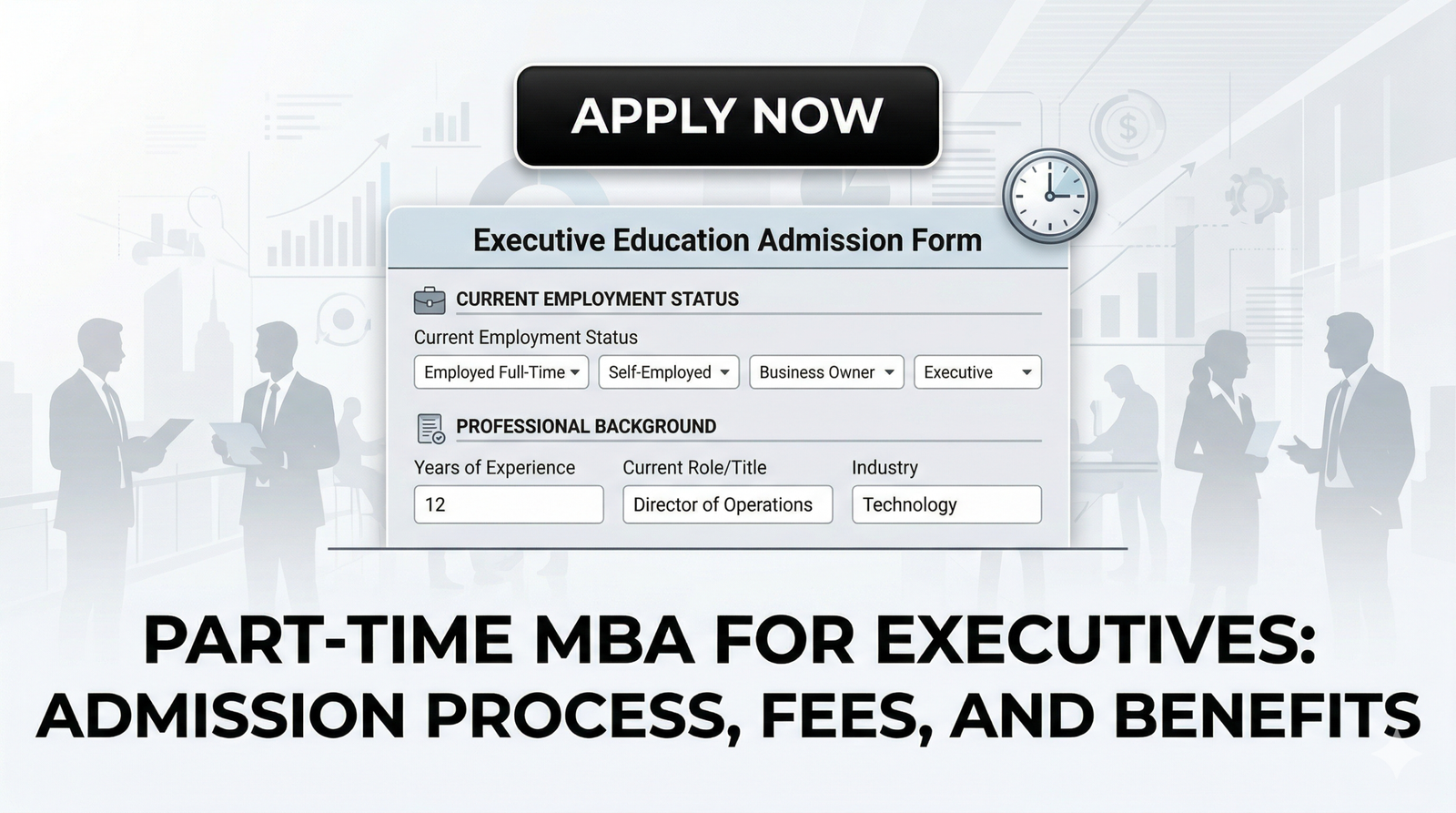
In the highly competitive corporate ecosystem of 2026, continuous learning is no longer just an option; it is a strict necessity for survival.
As mid-level managers strive to break into the C-suite, they often find themselves lacking the advanced strategic frameworks and leadership theories required at the highest levels of business.
Related Posts:


However, resigning from a well-paying, secure job to pursue a traditional two-year MBA is an incredibly risky and expensive proposition.
This exact professional dilemma has fueled the massive rise in popularity of the Part-Time MBA for Executives.
A Part-Time MBA offers the perfect middle ground. It delivers the same rigorous curriculum, esteemed faculty, and prestigious degree as a full-time program, but it is structured around the schedule of a working professional.
Classes are typically held during the evenings, on weekends, or through hybrid digital modules, allowing you to seamlessly balance your corporate responsibilities with top-tier academic training.
This comprehensive guide will explore every facet of a Part-Time MBA for Executives. We will dive deep into the immense benefits, the structured admission process, the expected fee structures, and the ultimate career rewards waiting at the finish line.
Detailed Benefits of a Part-Time MBA
Choosing to pursue a part-time MBA while maintaining your corporate career is a demanding but highly rewarding journey. Here is a detailed look at the core benefits.
1. Continuous Income and Lower Opportunity Cost
The most significant advantage is financial stability. By choosing a part-time format, you do not have to forfeit your monthly salary or your annual corporate bonuses.
Traditional MBA students lose two years of income, which drastically increases their overall “opportunity cost.” Part-time students completely bypass this massive financial burden.
2. Immediate Real-World Application
In a full-time MBA, you learn a concept and wait two years to apply it. In a part-time program, you learn a negotiation strategy on Saturday and use it in your boardroom on Monday.
This immediate application not only reinforces your learning but also showcases your newly acquired skills to your current employer, often leading to rapid, mid-program promotions.
3. High Probability of Corporate Sponsorship
Because you are staying with your current company, many employers view your MBA as a direct investment in their own leadership pipeline.
It is incredibly common for corporations to sponsor 50% to 100% of a part-time executive’s tuition fees, provided the employee signs a retention contract to stay with the company for a few years post-graduation.
4. Mature and Experienced Networking
Your classmates in a part-time executive program are not fresh college graduates. They are seasoned professionals, project managers, and directors from diverse industries.
The networking here is deeply practical. You are exchanging real-world business solutions, forming lucrative B2B partnerships, and gaining access to a mature, highly influential alumni network.
Eligibility Criteria for Executive Admissions
Because the curriculum assumes you have a foundational understanding of the corporate world, the eligibility criteria focus heavily on your professional track record.
- Extensive Work Experience: This is the ultimate deciding factor. Top-tier programs require a minimum of 3 to 5 years of full-time work experience. Elite executive cohorts often expect 7 to 10 years of progressive managerial experience.
- Undergraduate Degree: You must hold a recognized Bachelor’s degree from an accredited university. A consistently strong academic record (usually 50% or above) is expected, though work experience can offset a lower GPA.
- Standardized Tests: While traditional programs demand the GMAT or GRE, many part-time programs accept the Executive Assessment (EA), which requires far less preparation. Additionally, extensive work experience often qualifies you for a complete test waiver.
- Current Employment: You must be actively employed at the time of your application. Some universities require a formal “Letter of Consent” from your current employer acknowledging your time commitments to the program.
Required Documents for Admission
To secure a seat in a competitive part-time cohort, your application dossier must highlight your leadership capability and time-management skills.
- Detailed Executive Resume/CV: A highly structured resume showcasing your career trajectory, the revenue you have managed, and the specific sizes of the teams you have led.
- Statement of Purpose (SOP): A focused essay explaining why you need a part-time MBA at this specific stage of your career, and how you plan to balance the rigorous academic workload with your job.
- Letters of Recommendation (LORs): Two professional recommendations are mandatory. These must come from your current direct manager or a C-level executive who can accurately assess your leadership potential.
- Academic Transcripts: Official, stamped mark sheets and degree certificates from your undergraduate and any previous postgraduate institutions.
- Employer Letter of Support: A document from your HR department or CEO stating they support your academic endeavor and will accommodate your weekend or evening class schedules.
- Government ID and Photographs: A valid passport or national identity card, along with professional passport-sized photographs.
Top Universities, Fees, and Career Scope
To provide a clear perspective on the investment and returns, here are detailed tables outlining top programs, their fees, and the resulting career scope.
Table 1: Top Global Universities for Part-Time MBA (2026)
| University / Business School | Location | Program Format | Estimated Total Fees |
| Chicago Booth School of Business | USA | Evening / Weekend | $150,000 – $175,000 |
| Kellogg School of Management | USA | Evening / Weekend | $155,000 – $180,000 |
| NYU Stern School of Business | USA | Part-Time | $145,000 – $165,000 |
| IIM Bangalore (PGPEM) | India | Weekend | ₹20 Lakhs – ₹25 Lakhs |
| ISB (PGPpro) | India | Weekend Hybrid | ₹25 Lakhs – ₹30 Lakhs |
| London Business School (LBS) | UK | Executive Part-Time | £90,000 – £110,000 |
Table 2: Average Career Progression and Salaries
| Corporate Designation | Pre-MBA Role Equivalent | Average Salary Post-MBA (Global) | Average Salary Post-MBA (India) |
| Senior Vice President (SVP) | Mid-Level Manager | $160,000 – $200,000+ | ₹35 LPA – ₹55 LPA+ |
| Strategy Consulting Director | Senior Consultant | $150,000 – $185,000 | ₹30 LPA – ₹45 LPA |
| Chief Financial Officer (CFO) | Finance Controller | $180,000 – $250,000+ | ₹40 LPA – ₹70 LPA+ |
| General Manager (Operations) | Operations Lead | $130,000 – $160,000 | ₹25 LPA – ₹35 LPA |
Table 3: Part-Time MBA vs Full-Time MBA
| Feature | Part-Time MBA | Full-Time MBA |
| Target Audience | Working managers (4-10+ yrs exp) | Early professionals (1-4 yrs exp) |
| Class Schedule | Weekends and Evenings | Monday to Friday (Daytime) |
| Primary Goal | Climbing the current corporate ladder | Pivoting careers or industries |
| Campus Placements | Rarely offered (Students are employed) | Highly structured and guaranteed |
Online and Offline Application Process
Applying for a part-time MBA requires careful attention to deadlines, as these programs often have rolling admissions throughout the year.
The Online Application Process
- Create an Applicant Profile: Visit the official business school portal. Register using your primary email address to generate your unique application dashboard.
- Select the Correct Program: Ensure you select the “Part-Time” or “Weekend Executive” track, as universities have separate application funnels for their full-time programs.
- Fill the Detailed Form: Input your personal demographics, educational background, and a meticulous, chronological breakdown of your corporate employment history.
- Upload Documentation: Scan and upload your SOP, Executive Resume, LORs, Transcripts, and Employer Consent letters in high-resolution PDF format.
- Pay Application Fees: Pay the non-refundable processing fee via a secure international credit card, debit card, or net banking gateway.
- The Executive Interview: If shortlisted, you will face an intense interview round. This is often conducted by university alumni or the program director to assess your real-world business maturity.
The Offline Application Process
- Procure the Prospectus: Visit the university’s executive admissions office or regional center to purchase the physical part-time MBA brochure and application form.
- Fill Manually: Use a blue or black pen to carefully complete the form in block letters, ensuring there are no errors or overwriting.
- Attach Attested Copies: Enclose self-attested photocopies of your degree certificates, mark sheets, professional experience letters, and recent salary slips.
- Create a Demand Draft (DD): Visit your bank and generate a Demand Draft for the exact application fee, drawn in favor of the university.
- Submit Securely: Place the completed form, all supporting documents, and the DD in a sealed A4 envelope. Submit it via registered speed post or hand-deliver it before the deadline.
How to Check Admission List and Application Status
Because part-time programs cater to busy executives, universities usually have highly efficient, digitized tracking systems.
- Applicant Dashboard: Log into your university admission portal. The dashboard is the most reliable place to see real-time updates like “Application Under Review” or “Interview Scheduled.”
- Check Your Email: Executive admission committees communicate almost exclusively via email. Ensure you check your primary inbox and spam folder daily for official correspondence.
- Dedicated Enrollment Advisors: Part-time applicants are usually assigned a dedicated relationship manager or advisor. You can email or call them directly for personalized updates on your application.
- Official Merit Notices: For certain domestic institutions, final selection lists are published as secure PDFs on the university website. You can locate your status using your unique application ID.
Frequently Asked Questions (FAQs)
1. Will my degree certificate say “Part-Time MBA”?
No. The vast majority of top-tier universities issue the exact same “Master of Business Administration” degree to their part-time students as they do to their full-time students. The mode of study is rarely mentioned on the final diploma.
2. Is it possible to switch careers with a Part-Time MBA?
It is possible, but it is much harder than with a full-time MBA. Part-time programs do not offer summer internships, which are the primary stepping stones for massive career pivots (e.g., from Engineering to Investment Banking).
3. How do I convince my employer to sponsor my MBA?
You need to build a solid business case. Show them how the specific skills you will learn (like advanced data modeling or strategic marketing) will directly increase the company’s revenue or efficiency. Offer to sign a retention agreement in exchange for the funding.
4. How intense is the workload?
It is exceptionally intense. You will be working 40 to 50 hours a week at your job, and then spending an additional 15 to 25 hours on weekends attending classes, reading case studies, and completing group projects. Excellent time management is mandatory.
5. Do Part-Time MBAs offer campus placements?
Generally, no. Because part-time students are already fully employed, universities do not run traditional placement drives for them. However, you will get access to the university’s career center, alumni job boards, and executive coaching services.
6. Can I transfer to the full-time program later if I quit my job?
This depends entirely on the university’s policies. While a few schools allow transfers if you meet the full-time academic requirements, most top-tier institutions keep the two cohorts strictly separate to maintain the integrity of their programs.
Conclusion
Pursuing a Part-Time MBA for Executives in 2026 is the ultimate test of professional endurance, but it yields extraordinary corporate dividends. It is the ideal educational pathway for ambitious managers who want to shatter the glass ceiling without sacrificing their current career momentum or financial stability.
By strategically leveraging a part-time program, you gain immediate access to high-level strategic knowledge, an elite network of seasoned professionals, and the prestigious branding of a top-tier business school.
If you have the discipline to balance a demanding job with rigorous weekend academics, start preparing your application dossier. Approach your employer for potential sponsorship, craft a compelling SOP, and take the definitive step toward reaching the executive boardroom.