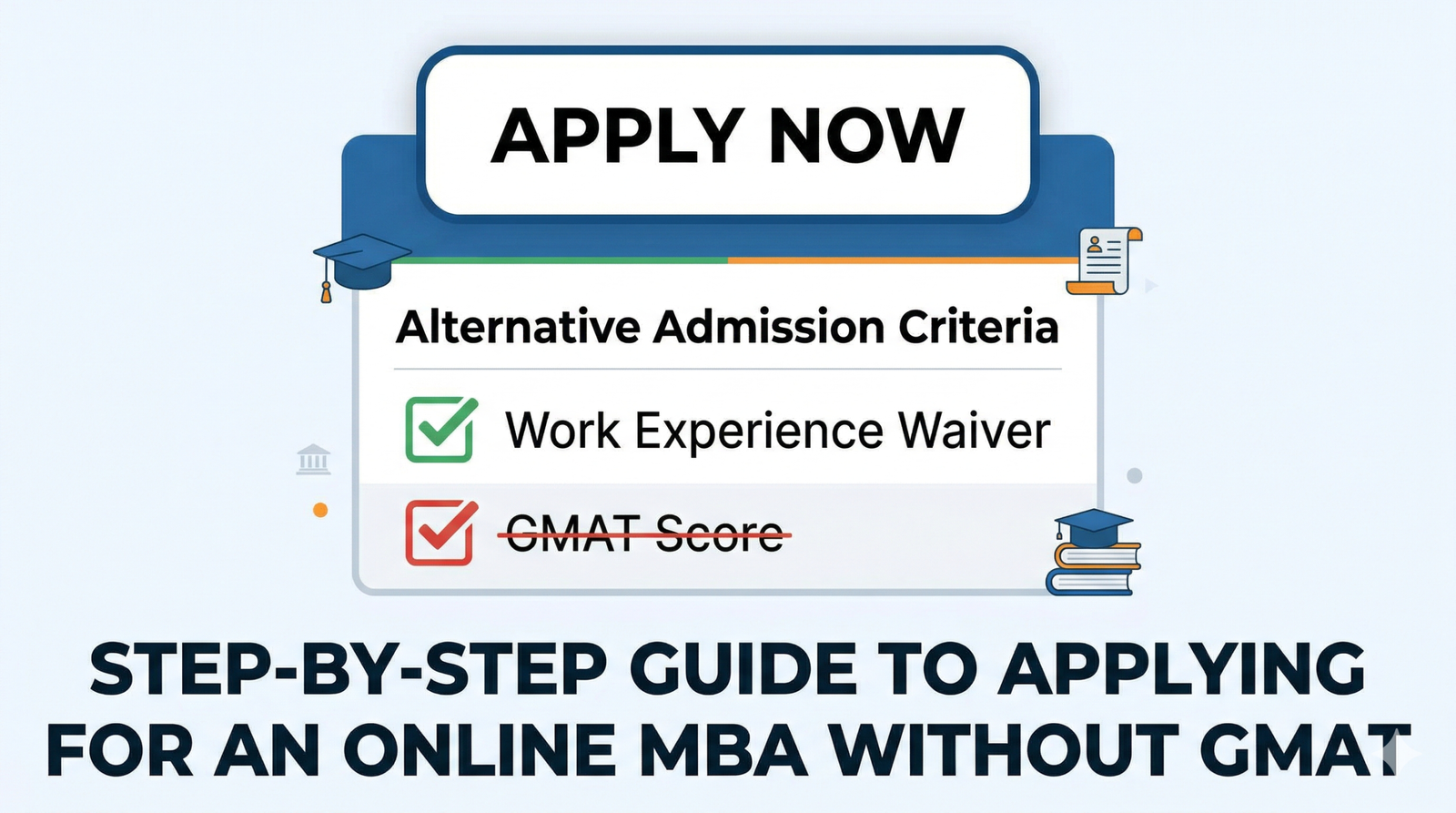
For decades, the Graduate Management Admission Test (GMAT) was the ultimate gatekeeper for anyone dreaming of a Master of Business Administration (MBA). As we progress through 2026, the educational landscape has dramatically shifted.
Top-tier global universities have finally realized that a standardized three-hour test does not accurately reflect a professional’s true leadership potential, strategic thinking, or business acumen.
Related Posts:

As a result, an increasing number of elite business schools are offering GMAT waivers or completely eliminating the test requirement for their online MBA programs. This is a massive relief for working professionals who simply do not have the hundreds of hours required to prepare for such a rigorous exam.
An online MBA without a GMAT requirement is not a “lesser” degree. It is the exact same rigorous, high-quality academic program, taught by the same esteemed faculty, and it yields the identical degree certificate upon graduation.
The admissions committees simply use different metrics to evaluate your capability. They look at your real-world corporate achievements, your undergraduate academic consistency, and your ability to manage teams.
This comprehensive guide is designed to walk you through the entire process. We will cover the profound benefits of skipping the GMAT, the specific eligibility criteria for waivers, the required documents, and a detailed step-by-step application strategy.
Detailed Benefits of a No-GMAT Online MBA
Choosing an online MBA program that does not require the GMAT offers several strategic advantages. Here is a detailed breakdown of why this path is highly beneficial for modern professionals.
1. Massive Savings of Time and Money
Preparing for the GMAT typically requires three to six months of intense, daily study. Additionally, the exam fee itself, along with expensive preparatory courses and mock tests, can cost thousands of dollars or lakhs of rupees.
By opting for a program with a GMAT waiver, you completely eliminate these financial and temporal burdens. You can immediately channel that saved time into your current job, your family, or starting your MBA coursework earlier.
2. Elimination of Standardized Test Anxiety
Many brilliant managers and executives suffer from severe test anxiety. They perform exceptionally well in boardrooms and high-pressure corporate negotiations but freeze during standardized, timed academic exams.
A no-GMAT pathway ensures that your admission is based on your actual, proven career track record rather than your ability to solve complex geometry or abstract reasoning puzzles under a ticking clock.
3. Faster Application and Admission Cycle
Scheduling a GMAT exam, waiting for the official scores, and then sending them to universities adds months to your application timeline. Without this requirement, the application process is incredibly swift.
You can literally decide to pursue an online MBA today, gather your documents within a week, and submit your application before the next immediate intake deadline.
4. Focus on Real-World Professional Value
Programs that waive the GMAT inherently value real-world corporate experience over academic theory. The cohorts in these programs are usually filled with seasoned professionals, entrepreneurs, and senior managers.
This creates a highly pragmatic, practical learning environment where classroom discussions are based on actual industry challenges rather than theoretical textbook scenarios.
Eligibility Criteria for GMAT Waivers
Universities do not simply hand out GMAT waivers to everyone. You must prove that you possess the analytical and quantitative skills necessary to survive a rigorous MBA curriculum. Here is how you qualify:
- Extensive Work Experience: This is the most common criterion. Top universities usually require a minimum of 3 to 5 years of full-time, progressive professional experience. Executive online MBAs may require 7 to 10 years of managerial experience to grant a complete waiver.
- High Undergraduate GPA: If you do not have extensive work experience, admissions committees will look closely at your Bachelor’s degree. A consistently high Grade Point Average (GPA), especially in quantitative subjects like math, economics, or engineering, can easily secure a waiver.
- Professional Certifications: Holding advanced professional certifications proves your quantitative and analytical rigor. Certifications like Chartered Accountant (CA), Certified Public Accountant (CPA), or Chartered Financial Analyst (CFA) almost always guarantee a GMAT waiver.
- Alternative Executive Assessments: Some universities might waive the GMAT but ask you to take a much shorter, less demanding test, such as the Executive Assessment (EA), which requires minimal preparation.
- Postgraduate Degrees: If you already hold a Master’s degree in a rigorous field (like an M.Tech, MS in Data Science, or MA in Economics), most admission boards will automatically waive the GMAT requirement.
Required Documents for Admission
When you remove the GMAT from the equation, the rest of your application must be absolutely flawless to prove your merit. You must meticulously prepare the following documents:
- Detailed Executive Resume/CV: This is your primary weapon. Highlight your career progression, the size of the teams you have managed, the budgets you have controlled, and quantifiable business impacts (e.g., “Increased Q3 sales by 15%”).
- Statement of Purpose (SOP): A highly customized essay explaining why you are pursuing an online MBA now, why you are requesting a GMAT waiver, and how your past professional experience proves your readiness for the program.
- Letters of Recommendation (LORs): You will need two to three strong LORs from direct supervisors or C-level executives. They must explicitly mention your analytical thinking, leadership skills, and ability to handle complex projects.
- Academic Transcripts: Official, stamped transcripts from all your undergraduate and previous postgraduate institutions.
- Waiver Request Letter: Some universities require a separate, formal one-page letter formally requesting the GMAT waiver, citing the specific university policies you meet (e.g., meeting the 5-year work experience threshold).
- Government ID and Photographs: A valid passport or national ID card, along with recent professional passport-sized photographs.
Top Universities Offering No-GMAT Online MBAs
To give you a clear perspective on the caliber of institutions adopting this modern approach, here are tables detailing top universities and the massive career scope they offer.
Table 1: Top Global Business Schools with GMAT Waivers (2026)
| University / Business School | Location | GMAT Waiver Condition | Estimated Program Duration |
| Syracuse University (Whitman) | USA | 3+ Years Work Experience | 24 Months |
| University of North Carolina (Kenan-Flagler) | USA | 5+ Years Work Experience | 18 to 36 Months |
| Warwick Business School | UK | Strong Academic / Corporate Record | 24 Months |
| Amity University (Online) | India | Direct Admission on Merit | 24 Months |
| Northeastern University (D’Amore-McKim) | USA | High Undergraduate GPA | 24 Months |
| Symbiosis Centre for Distance Learning | India | Direct Admission on Merit | 24 Months |
Table 2: Career Scope and Average Salary Post-MBA
| Target Job Role | Core Responsibilities | Average Starting Salary (Global) | Average Starting Salary (India) |
| Operations Director | Optimizing supply chains and managing daily logistics. | $110,000 – $145,000 | ₹18 LPA – ₹28 LPA |
| Senior Management Consultant | Advising corporations on strategy, mergers, and restructuring. | $130,000 – $160,000+ | ₹20 LPA – ₹35 LPA+ |
| VP of Business Development | Expanding market reach and driving massive enterprise sales. | $120,000 – $155,000 | ₹22 LPA – ₹40 LPA |
| Chief Marketing Officer (CMO) | Leading global brand strategy and digital marketing campaigns. | $140,000 – $180,000+ | ₹25 LPA – ₹50 LPA+ |
Online and Offline Application Process
Navigating the application process correctly is crucial when applying for a waiver. Following these exact steps will ensure your profile is evaluated favorably.
The Online Application Process
- Portal Registration: Visit the target university’s official online MBA admissions portal. Create a secure account using your email ID to generate your application reference number.
- Select the Waiver Option: During the application, carefully look for the “Standardized Tests” section. Check the box that says “Apply for GMAT Waiver” or “Test-Optional Application.”
- Fill the Comprehensive Form: Input your personal details, academic history, and a detailed, chronological breakdown of your corporate work experience.
- Upload Digital Documents: Scan and upload your Executive Resume, SOP, LORs, Transcripts, and the specific Waiver Request Letter in high-resolution PDF format.
- Pay the Application Fee: Process the non-refundable application fee using an international credit card, debit card, or secure net banking gateway.
- Virtual Interview: Since you have no GMAT score, the interview is highly critical. If shortlisted, you will face a rigorous video interview via Zoom to test your communication and analytical skills.
The Offline Application Process
- Procure the Form: If the university permits offline applications, visit their regional center or campus to purchase the official admission brochure and physical form.
- Fill Details Manually: Use a blue or black pen to fill out the form in capital letters. Clearly attach your GMAT Waiver Request Letter as the first page of your document stack.
- Attach Photocopies: Enclose self-attested photocopies of your degree certificates, mark sheets, professional experience letters, and recent salary slips.
- Generate Demand Draft (DD): Go to your bank and create a Demand Draft for the exact application fee amount, payable to the university’s admission board.
- Secure Submission: Place the fully completed form, the DD, and all supporting documents in a sealed A4 envelope and submit it via registered speed post before the deadline.
How to Check Admission List and Application Status
Waiting for a waiver approval and final admission decision can be nerve-wracking. Here is how you can track your application smoothly.
- Applicant Dashboard: Log back into the university’s admission portal. The dashboard will show real-time updates, specifically indicating if your “GMAT Waiver Approved” status has been updated.
- Email Communications: Admissions teams will officially notify you via email if your waiver is accepted or if they require additional proof of your quantitative skills. Always check your spam folder.
- Official Notice Boards: Some universities publish final selection and merit lists as downloadable PDFs on their official websites. You can search these documents using your application ID.
- Follow Up with Counselors: If weeks have passed without an update on your waiver request, politely email or call your assigned admissions counselor for a status update.
Frequently Asked Questions (FAQs)
1. Will an online MBA without a GMAT hold the same value?
Yes, absolutely. Once you graduate, your degree certificate does not mention whether you submitted a GMAT score during the admission process. Employers value the university’s reputation, the skills you acquired, and your actual job performance.
2. What if my GMAT waiver request is rejected?
If the admission committee feels your profile lacks quantitative proof, they may reject the waiver. In this case, they will either ask you to take the GMAT/EA or offer you conditional admission, requiring you to complete a foundational math course before the semester begins.
3. Can fresh graduates apply without a GMAT?
It is very difficult. GMAT waivers are primarily designed for experienced professionals. If you are a fresh graduate with zero work experience, top universities will almost certainly require a GMAT or GRE score to evaluate your academic capability.
4. Do I still need an interview if my GMAT is waived?
Yes, the interview becomes even more important. Because the university does not have a standardized test score to judge you by, they will use the virtual interview to rigorously assess your critical thinking, leadership maturity, and cultural fit.
5. Are there specific industries that demand a GMAT score post-MBA?
Very rarely. Some elite strategy consulting firms (like McKinsey or BCG) used to ask for GMAT scores during job interviews years ago. However, in 2026, recruiters care far more about your MBA grades, your case-study interview performance, and your past work experience.
6. Can I get a scholarship without a GMAT score?
Yes, but it is more challenging. While universities offer GMAT waivers for admission, merit-based financial scholarships are highly competitive. A strong GMAT score makes getting a scholarship much easier, but an exceptional professional background can also secure funding.
Conclusion
The decision by top universities to waive the GMAT requirement is a monumental shift in the world of executive education. It democratizes access to elite MBA programs, allowing brilliant, hardworking professionals to upgrade their qualifications without the grueling burden of standardized testing.
Applying for an online MBA without a GMAT means your real-world experience, your leadership track record, and your strategic vision finally take center stage.
By carefully identifying the universities that value your specific professional background, drafting a highly compelling Statement of Purpose, and showcasing your quantitative achievements on your resume, you can seamlessly secure admission. Take the time to build an airtight application dossier, and step confidently into the next high-paying phase of your corporate career in 2026.